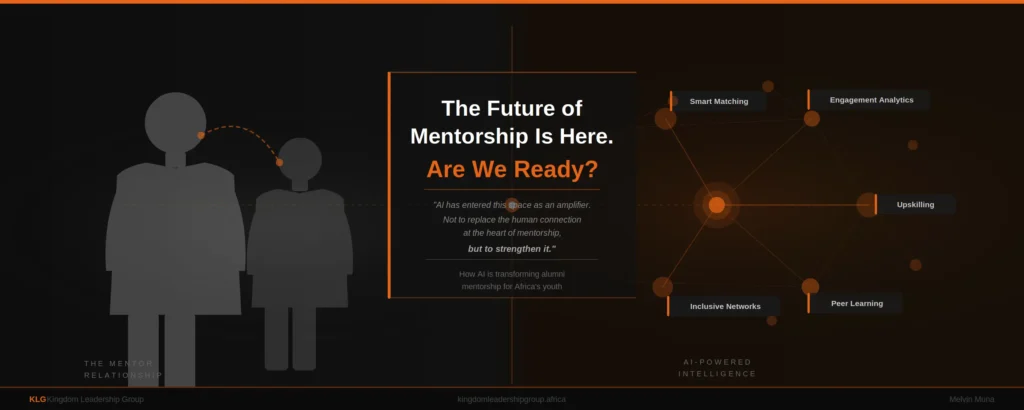
Mentorship has changed lives across Africa for generations. Young people who found the right mentor at the right moment have gone on to build careers, lead organisations, and open doors for others coming after them. The evidence is everywhere. And yet, if we are honest with ourselves, the systems we have built to deliver mentorship at scale are struggling to keep up.
This is not a criticism of the people running these programs. It is an honest look at the structural limitations of traditional mentorship models and the remarkable opportunity we now have to address them.
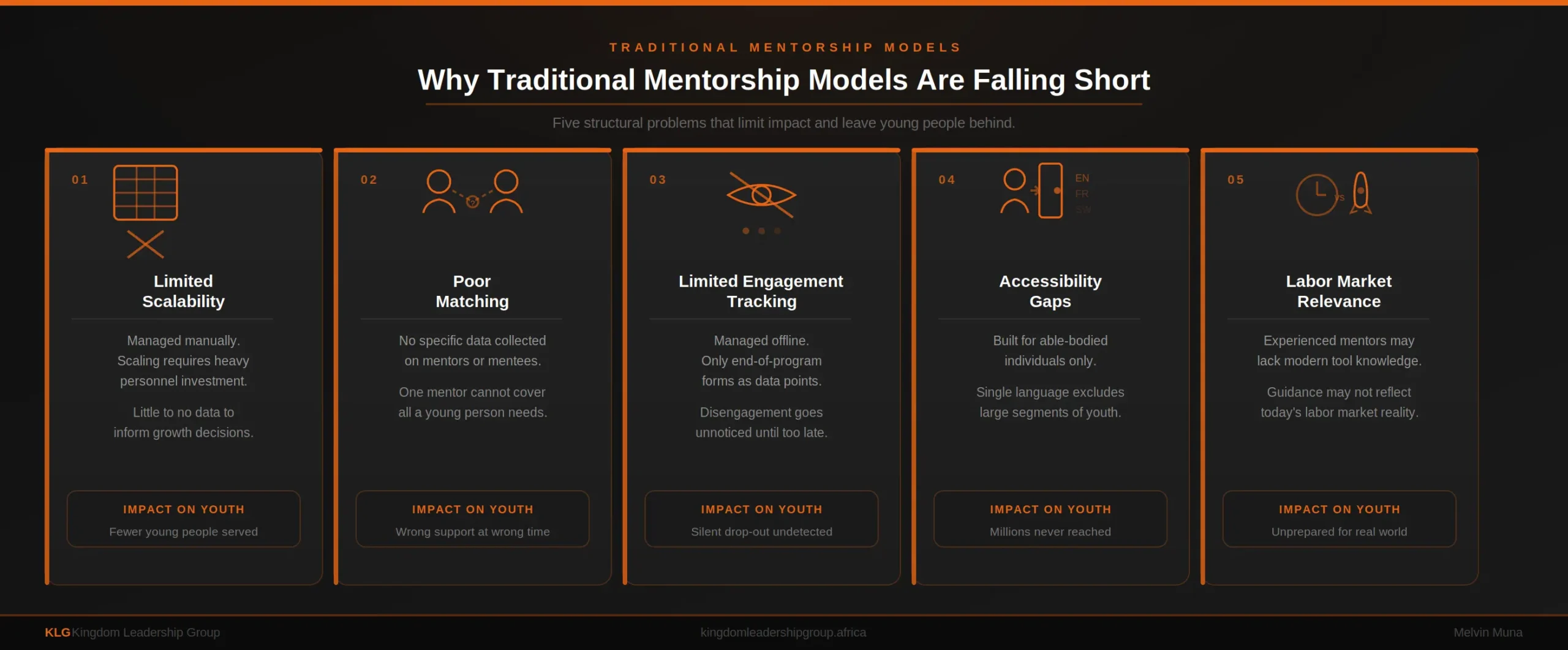
Why Traditional Mentorship Models Are Falling Short
Before we talk about solutions, we need to name the problems clearly.
Limited Scalability
Most mentorship programs are managed manually. Every match is made by a human coordinator. Every follow-up is tracked on a spreadsheet or not tracked at all. As a result, growing these programs requires significant investment in personnel, and without sufficient data to inform decisions, organisations are essentially guessing what works and what does not.
Poor Matching
The quality of a mentorship relationship depends entirely on the quality of the match. Yet most traditional programs do not collect specific enough data on mentors or mentees to make intentional pairings. Beyond that, the one mentor per mentee model places an unrealistic burden on a single individual. A young person navigating their career transition may need guidance on job searching, industry knowledge, confidence building, and networking all at once. One mentor, however experienced, cannot adequately cover all of that.
Limited Engagement Tracking
Traditional programs are largely managed offline. Outside of an end-of-program feedback form, there is very little data being collected on what is actually happening inside the mentorship relationship. Program managers have limited visibility into who is thriving, who is disengaging, and who has already quietly dropped out before anyone noticed.
Accessibility
The majority of traditional mentorship programs are built for able-bodied individuals and operate in a single language. This is not intentional exclusion, but the result is the same. Large segments of young people who could benefit enormously from mentorship are never reached because the program was simply not designed with them in mind.
Labor Market Relevance
The traditional model pairs an older, experienced professional with a young person. That mentor brings real value. But experience alone does not always translate into familiarity with the modern tools and technologies that define success in today’s labor market. A mentor who has not engaged with AI tools, remote work platforms, or digital professional branding may be unable to adequately prepare a young person for the reality they are walking into.
What AI Can Actually Do for Mentorship
AI does not replace the human connection at the heart of great mentorship. What it does is remove the friction that prevents that connection from forming and from lasting. Here is where the impact is most significant.
Improving Career Guidance
Smart matching connects mentees with mentors based on genuine fit, not just who is available. More importantly, it enables a need-based model where a mentee can be connected with multiple mentors, each with specific expertise in the areas the young person needs most.
Consider Amara, a recent graduate with three clear development needs:
- Building a strong professional profile.
- Becoming remote work ready.
- Developing strategic networking skills.
Rather than being paired with one mentor and hoping they cover all three, the system matches her with three separate mentors. The first is an experienced professional who has built a strong profile that has opened countless doors for her. The second is a seasoned remote work professional who understands exactly what it takes to thrive in distributed work environments. The third is a well-connected industry leader who knows how to build relationships that create real career opportunities.
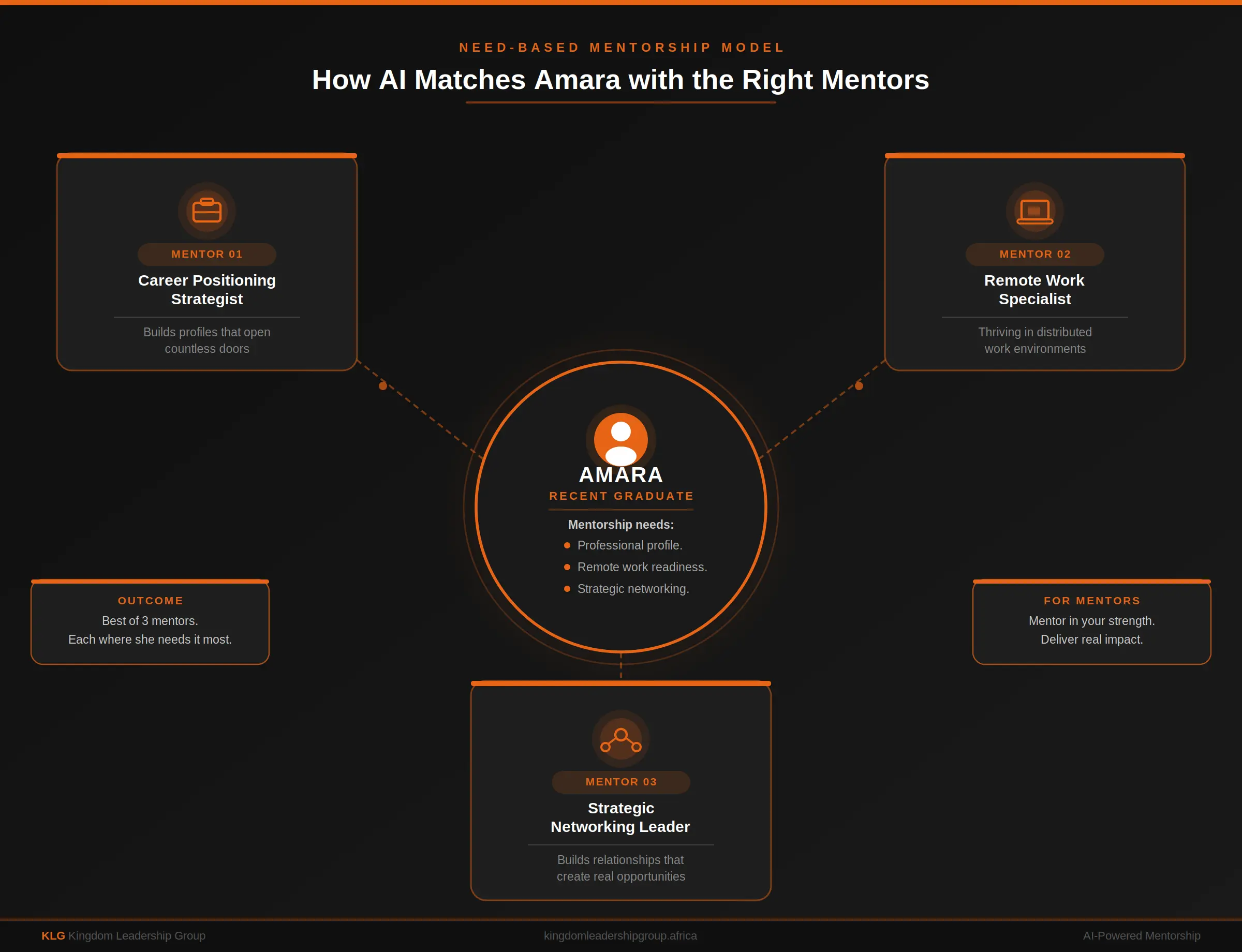
Through this model, Amara is not receiving one person’s perspective on her career. She is receiving the best qualities, experiences, and expertise of three mentors, each excellent in exactly the area she needs them most.
This model is equally powerful for the mentors themselves. Each mentor is contributing in the area they are genuinely strongest in, with no pressure to be everything to someone. That focus builds confidence, and confident mentors show up better. When mentors operate within their strengths, their support delivers tangible results and real impact for the young people they serve. That impact is what keeps them motivated, engaged, and committed to giving their best.
The result is more focused, more useful relationships that actually move careers forward.
Enhancing Alumni Engagement and Peer Learning
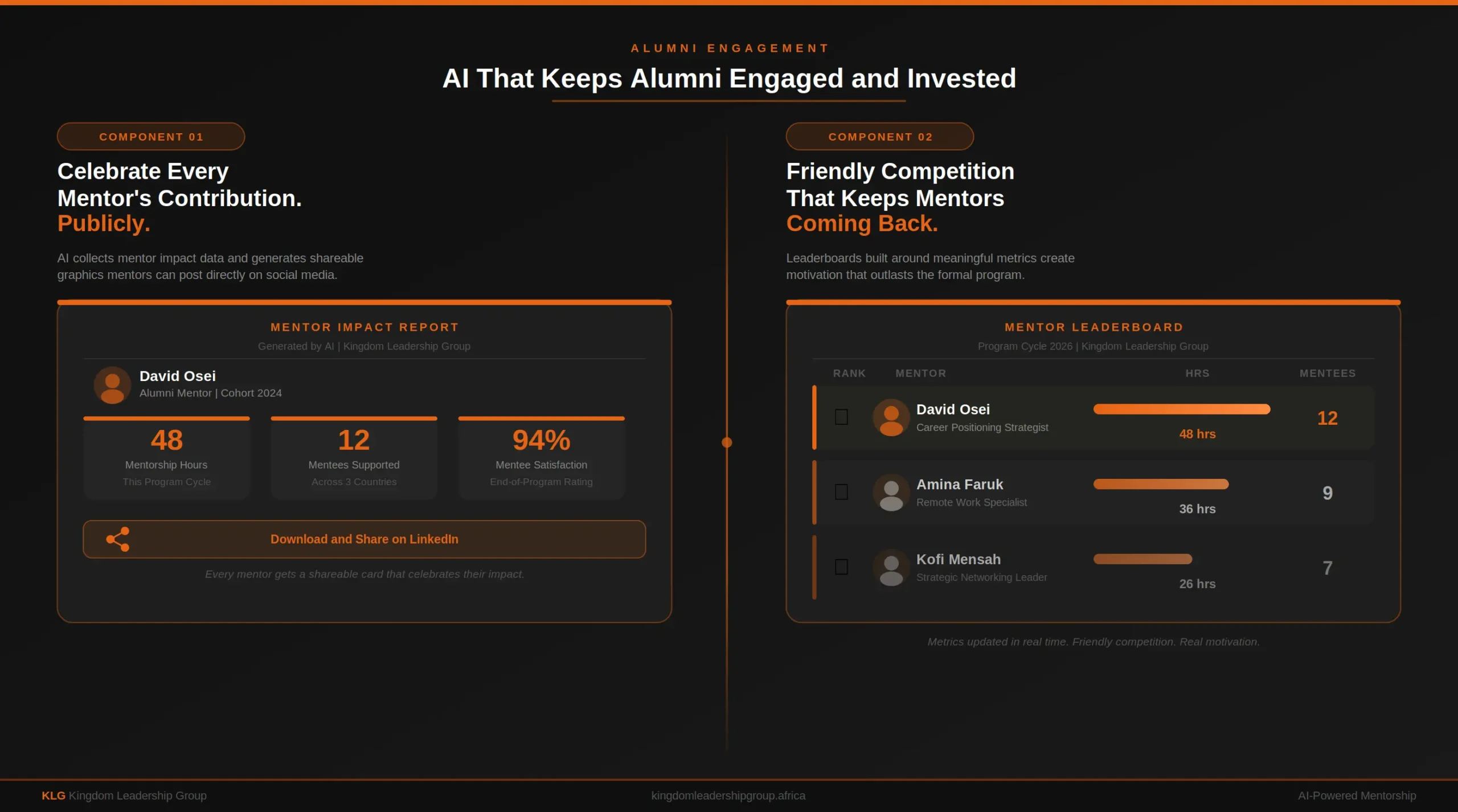
AI can collect impact data from mentor activity and generate graphics that mentors can download and share on their own social media, celebrating their contribution and extending the visibility of the program. Leaderboards built around meaningful metrics like mentorship hours and number of mentees supported create a layer of friendly competition that keeps alumni active and invested long after their formal involvement ends.
On the peer learning side, AI can group mentees with shared interests and development needs together, creating intentional communities where young people interact, share experiences, and learn from each other. The mentor-mentee relationship is powerful, but the peer layer is equally important and often underutilised.
Supporting Inclusive Professional Networks
AI-enabled platforms can serve differently-abled mentors and mentees through sign language translation, live transcription, and accessibility features. Multi-language support broadens participation on both sides of the relationship, ensuring the program serves the full diversity of the communities it is designed to reach.
Equipping Young People for the Future of Work
AI can analyse a young person’s development needs and interests and make targeted recommendations for upskilling, connecting them to free resources and platforms where they can build relevant skills at their own pace. The goal is not just mentorship for today. It is building capability that outlasts the program.
The Principles Behind a Better System
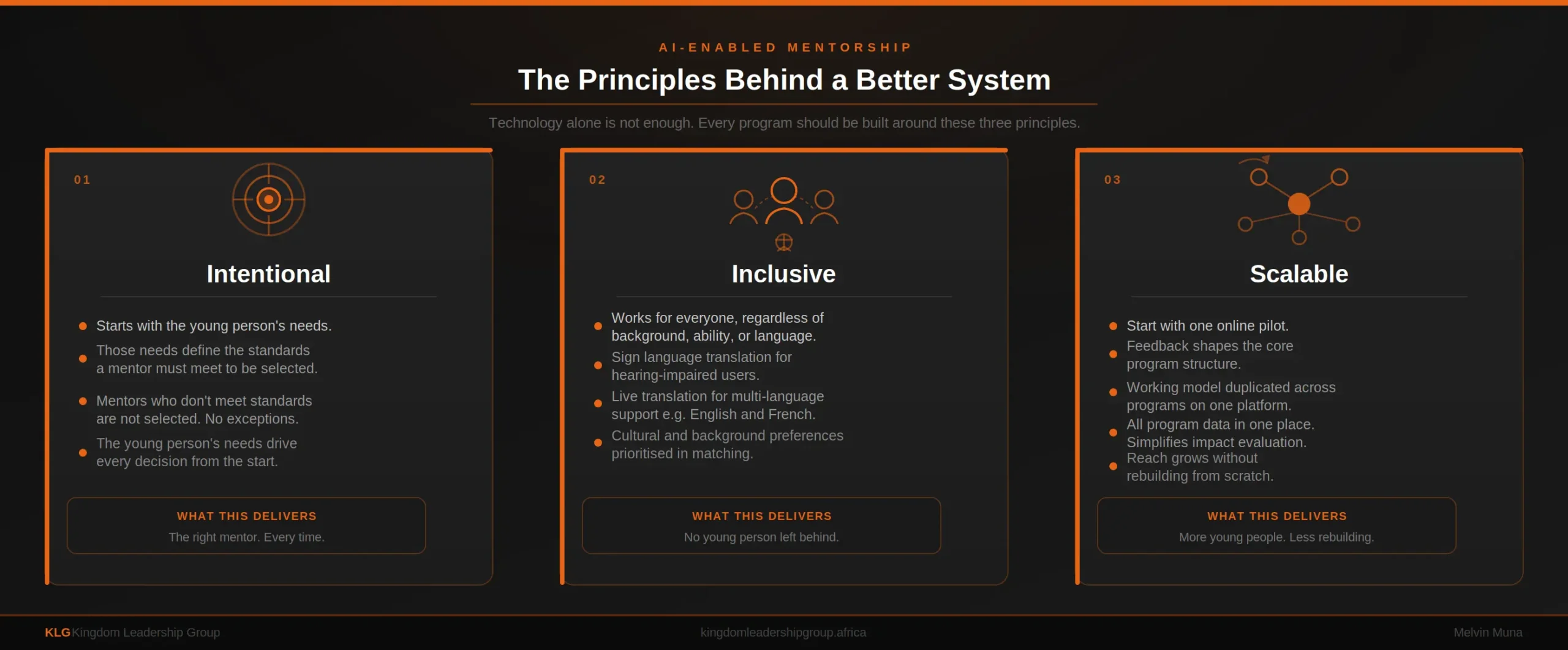
Technology alone is not enough. How we design AI-enabled mentorship programs matters as much as the tools we use. I believe every program should be built around three principles.
Intentional
Intentionality starts with the young person. Before any matching happens, we need to understand what the mentee actually needs. Those needs then define the standards a mentor must meet to be selected into the program. Mentors who do not meet those standards are simply not selected. This may feel rigid, but it is the only way to guarantee that the young person’s needs are at the centre of every decision.
Inclusive
An inclusive mentorship program is one that works for everyone, regardless of background, ability, or language. Sign language translation supports users with hearing impairments. Live translation and transcription enable multi-language support, so a program running in English can simultaneously serve a French-speaking mentee. Mentees should also be able to add preferences based on their cultural background, religion, and personal context, with AI prioritising those preferences during matching.
No young person should be excluded because the program was not built with them in mind.
Scalable
Scalability begins with one online pilot. The feedback from that pilot informs the core program structure. Once there is a working model, it can be duplicated across multiple programs with brand customisation, all running from the same platform. All program data sits in one place, simplifying impact evaluation and making continuous improvement possible. Multi-language and sign language support extend reach to a wider audience without requiring a complete rebuild every time you enter a new context.
Upskilling as a Mentorship Outcome
One of the most powerful things an AI-enabled mentorship platform can do is make personalised upskilling recommendations based on a mentee’s development needs and interests. Rather than pointing every young person to the same generic resource, AI can identify the specific skills they need and connect them to free platforms where they can build those skills on their own terms.
This matters because the labor market will keep changing. The skills that open doors today may not be sufficient in three years. A mentorship program that leaves young people with lasting capability, not just a network, is one that genuinely invests in their future.
How to Get Started Right Now
Many organisations feel they cannot act on AI-enabled mentorship yet because they do not have the budget for an end-to-end platform. That should not stop them from starting.
Here is what any organisation can do right now, with tools that already exist and most of which are free.
Build Independent AI Tools for Specific Tasks
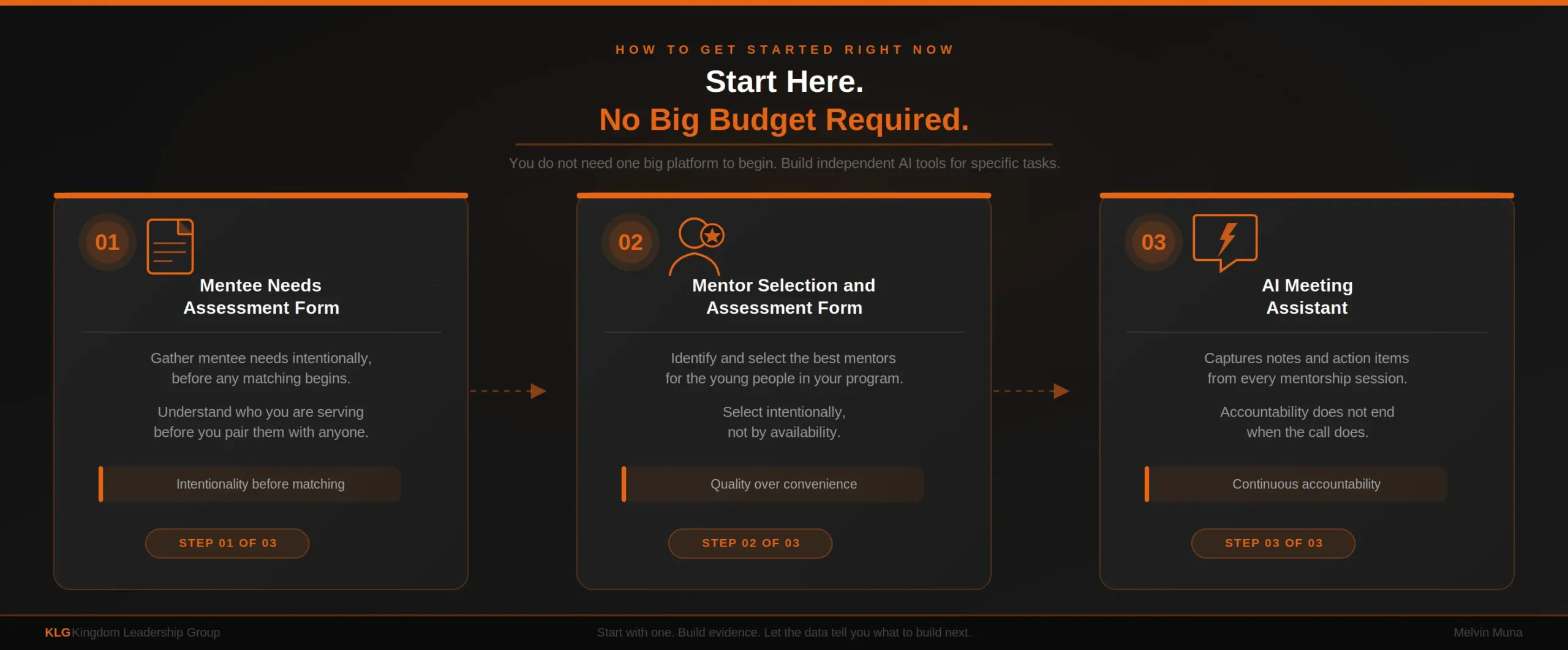
You do not need one big platform to begin. You can create separate AI-powered tools for specific functions:
- An application form that gathers mentee needs intentionally, before any matching begins.
- A mentor assessment form designed to identify and select the best mentors for the young people in your program.
- An AI meeting assistant that captures notes and action items from every mentorship session, keeping both mentor and mentee accountable between meetings.
Use AI Translation Tools for Immediate Multi-Language Support
Free and accessible AI translation tools are available right now. Organisations can use them to begin serving mentees across language groups without waiting for a fully built multilingual platform.
Start with one tool. Build evidence. Let the data inform what you build next.
Conclusion
Mentorship has always been one of the most powerful forces in a young person’s career journey. AI gives us the opportunity to make it more intentional, more inclusive, and more scalable than ever before. The young people coming up behind us deserve a system that was built with them in mind.
The question is not whether to use AI in mentorship. It is whether we will use it with the care and intentionality the people we serve deserve.